Welcome to the sixth Harvest of the Month: Daikon radish!
Daikon radish will be available at your school on Monday, April 5th.
What to do?
- Contact your teacher to schedule a time for your tasting.
- Check with your teacher if any students have food allergies.
- Take the Harvest of the Month home and prepare them for your tasting! There are many recipe ideas included in the handouts, but you can always keep it simple.
- Look over the curriculum and plan key education nuggets you think your class will enjoy.
- Return the green canvas bag the produce came in to the pick up location.
Resources
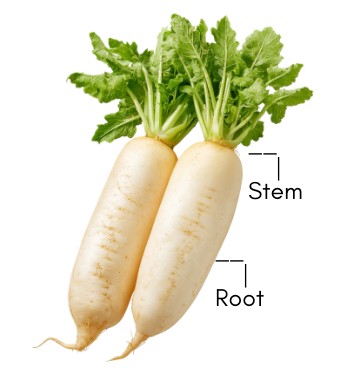 Let’s talk daikon
- What does daikon mean in Japanese? (Hint: it means “big root”!)
- Have you ever crunched a slice?
- Would you try it raw or cooked?
Botanical facts
- Scientific name: Raphanus Sativus Var. Longipinnatus
- Family: Brassicaceae
- Classification: Root Vegetable
Reasons to eat
- Daikon is about 93% water, so it is wonderfully crisp and refreshing.
- Vitamin C supports immune function and helps with tissue repair.
- Folate is important for cell growth and DNA synthesis.
Produce tips
- Trim the leafy greens. Wrap the radish in a damp paper towel, place it in a perforated plastic bag, and refrigerate for 1–2 weeks.
- For longer storage, freeze it for up to 6 months.
How does daikon grow?
- Daikon is a cool-season root vegetable that likes loose, well-draining soil.
- Give it 6–8 hours of full sun and consistent moisture.
- Plant in late summer to early fall for a fall/winter harvest, or in early spring in cooler climates.
- Most daikon are ready in 50–70 days.
- Best steady growth happens between 50 and 65 degrees.
Daikon radish fun facts
- Daikon is a Japanese word meaning “big root.” It can grow up to 20 inches long and weigh several pounds. It can even grow in large containers.
- Its enzymes can help clean and deodorize surfaces. Daikon is featured in Korean kimchi.
- In Japan, daikon is culturally important and appears in traditional festival dishes.
- Daikon likely originated in Ancient India, then spread to China, Korea, and Japan.
- Today, it grows in several California locations, especially the San Joaquin Valley, on small specialty farms and larger commercial farms.
Daikon radish recipes
Daikon Crunch Sticks
- Peeled daikon radish
- A little lemon juice
- Salt or mild seasoning
Steps:
- An adult cuts daikon into sticks.
- Toss with lemon juice and seasoning.
- Chill before serving.
Ask an adult for help with cutting!
Have Harvest of the Month questions? Please email communityhealth@tfhd.com.