Welcome to the fifth Harvest of the Month: Grapefruit!
Grapefruits will be available at your school on Monday, March 15th.
What to do?
- Contact your teacher to schedule a time for your tasting.
- Check with your teacher if any students have food allergies.
- Take the Harvest of the Month home and prepare them for your tasting! There are many recipe ideas included in the handouts, but you can always keep it simple.
- Look over the curriculum and plan key education nuggets you think your class will enjoy.
- Return the green canvas bag the produce came in to the pick up location.
Resources
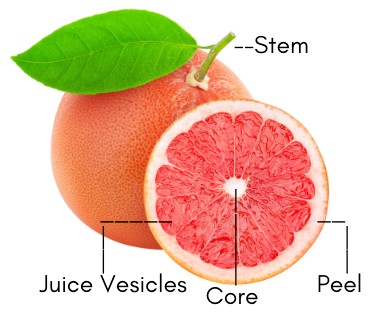 Let’s talk grapefruit
- Have you tasted grapefruit before?
- What does it taste like to you? Is it sweet or sour or both?
- Have you every had a grapefruit bigger than an orange?
Botanical facts
- Scientific name: Citrus Paradisi
- Family: Rutaceae
- Classification: Subtropical Citrus Fruit
Reasons to eat
- Grapefruit has essential nutrients, including vitamin C, vitamin A, potassium, fiber, and antioxidants.
- A medium grapefruit can provide 100% of your daily vitamin C requirement and over 50% of your vitamin A needs.
Produce tips
- Choose grapefruit with slightly red or orange peel. Deeper color often means stronger flavor.
- Store at room temperature for up to 10 days, or in the refrigerator for up to 3 weeks.
How do grapefruit trees grow?
- Grapefruit trees are broadleaf evergreen citrus trees. They keep their leaves all year and grow best in subtropical to tropical climates.
- They are sensitive to cold and need at least 8–10 hours of direct sun.
- Their season is December–May, with a January–April peak.
- They grow best from 55–100 degrees.
- Fruit is ready about 2–3 months after flowering.
Grapefruit fun facts
- It was once called the “forbidden fruit.”
- The name grapefruit comes from grape-like clusters on trees.
- There are over 20 varieties, from tart to slightly sweet.
- Trees can grow up to 20 feet tall and live over 50 years.
- The largest recorded grapefruit weighed 11 pounds, 9.7 ounces and grew in Brazil.
- Grapefruit emerged in Barbados during the 18th century from an accidental sweet-orange and pomelo cross. It arrived in 1823; its thick skin and bitter taste initially limited its popularity.
- California is the leading grapefruit-producing state.
- In the 2022–23 season, California produced over 160,000 tons.
- Grapefruit grows in the Coachella Valley and part of the San Joaquin Valley.
Grapefruit recipes
Grapefruit Sunshine Cups
- grapefruit sections
- plain or vanilla yogurt
- granola or cereal
Directions:
- An adult peels and cuts the grapefruit.
- Layer grapefruit and yogurt in a cup.
- Top with granola or cereal.
Ask an adult for help with cutting!
Check out these other great recipes
Have Harvest of the Month questions? Please email communityhealth@tfhd.com.